Coaching presence with NLP

If you’ve studied at a coaching school, you know that coaching presence is one of the ICF core competencies. The description can be confusing in that it’s not easy to know how to be curious, engaged, manage your emotions, and allow space for reflection, all at the same time. People deal with the problem either […]

Is NLP a Pseudo-Science?
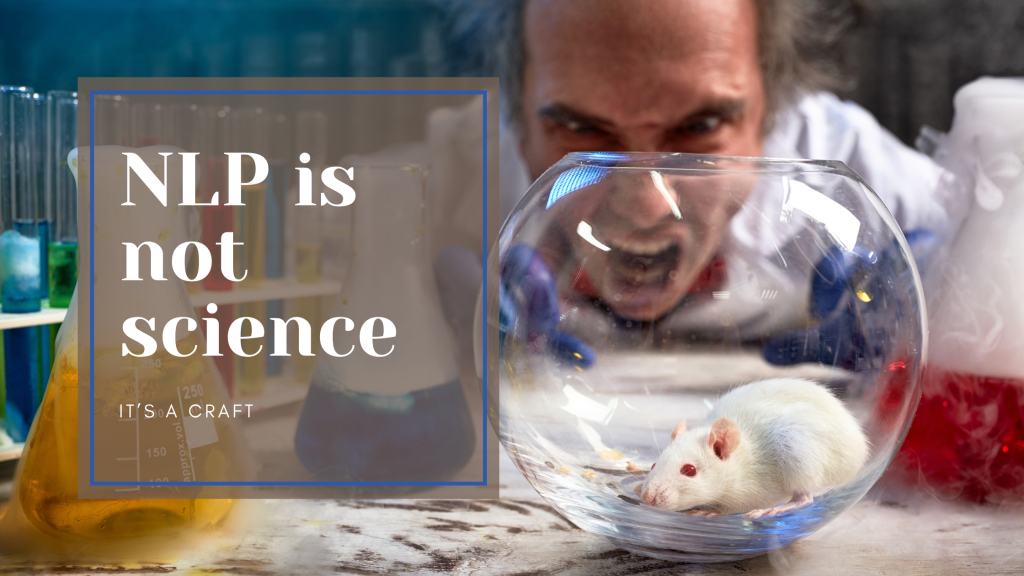
NLP is a craft, not a science

NLP as taught at NLP Canada Training is neither a science nor a pseudoscience. It’s a set of practical tools that are updated to align with current science and provide a bridge from science to the choices you make everyday. You can think of it as an art or a craft, a way of understanding life that draws on science and experience and practice.

We make change happen here
At NLP Canada Training, we believe that we can only lead change by practicing it. This year, we are changing the format and requirements for our Master Practitioner Training. We’ve introduced new material and formats to the Trainers’ Training. We’re also looking forward to launching nlpcanadacoaching.ca in the new year, a website that will provide […]

Prepare to make better choices

Late spring woods

If you had to give an important presentation or compete in a tournament, you would prepare. You’d probably think about what you were eating and drinking, how you were sleeping and exercising, and the skills and resources you would need to be ready to go. How do you prepare for making an important decision? Thinking […]

The Art of Guess and Test

Notice. Guess. Test.

In NLP courses, we learn to build rapport and read changes in ourselves while we are connected to others. The mind you read is always your own, but it is your mind under the influence of someone else’s thoughts and feelings

Is the world a friendly place?
You don’t have to believe the world is a friendly place. But if you work at believing it, you’ll probably live a longer, stronger life.

How Well Do You Know You?

You don’t have to leave your chair to explore, but you do have to step away from the illusion that the person sitting in the chair is someone you already know. In fact, you’ve known them for your whole life, and yet there is so much more to know.

3 Drivers of Growth: Purpose, Process & Perspective
Maybe you’re curious about how to connect what you read in short posts to an 8 day course online. You might have read big claims for NLP, or heard from friends that it changed their lives. How? It takes three things to take action that leads to predictable, positive results in your life and work: […]

Who are you and what do you want?
People often associate mindfulness with peace or calm. This is more or less like thinking that steam is the reason for coffee. A hot cup of coffee will result in steam and mindfulness will result in calm But that’s not the point. We live in a world where change is inevitable. That means we need […]

The NLP Practitioner Certification Details and Pricing

NLP Canada Training Practitioner Certification


At NLP Canada Training, you’ll work with a community that turns the best evidence into

practical techniques. Ask questions, practice hard, and have fun while you learn to make

change happen in you and around you.

Course Content

The course is structured to allow practice of the four core skills of NLP: managing state; managing rapport and connection; recognizing patterns in language and behaviour; and setting effective intentions and goals. Each day, different aspects of these skills are learned in relation to solving a problem or developing a direction. The course includes recognizing and making the most of emotions, connections, limited resources, stress, negotiation and collaboration, influence, and learning and development.

Pricing

Individual plus Individual Application Sessions (3) $2285 + tax

Individual $1885 + tax

Couples, Groups, Retired Seniors, or Full-Time Students, $1425 + tax per person

NLP Practitioner plus the NLP Master Practitioner, $3285 + tax per person

*Tax is applied depending on the province or country in which you reside.

Payment Plans

We’ll work with you to develop a payment plan you can manage. A deposit of 20% of the course fee is required to secure your registration. This is non-refundable.


Payment can be made in full or by installments (normally 3-5). Installment payments are made through QuickBooks payments. Payment in full can be made by QuickBooks (through your bank or credit card) or by EFT.

Live on Zoom

Training is live on Zoom and you will spend most of your time in a breakout space with one or two other people. Days run from 10:00 AM Eastern to 5:30 PM Eastern (Adjust for your time zone). We never record and we do not allow recording.

Dates for 2026/27

Season


Start

All Session Dates

Summer/Fall 2026

Fri. Sept 11

Fri/Sat/Sun Sept 11/12/13 and Oct 2/3/4 and Oct 17/18

Fall 2026

Fri. Oct 30

Fri/Sat/Sun Oct 30/31/Nov 1 and Fri/Sat/Sun Nov 13/14/15 and Sat/Sun Nov 28/29

Winter 2027

Fri. Jan 22

Fri/Sat/Sun Jan 22/23/24 and Fri/Sat/Sun Feb 5/6/7 and Sat/Sun Feb 20/21

Spring 2027

Fri. Mar 5

Fri/Sat/Sun Mar 5/6/7 and Fri/Sat/Sun Mar 19/20/21 and Sat/Sun Apr 3/4

Late Spring 2027

Fri. Apr 23

Fri/Sat/Sun Apr 23/24/25 and Fri/Sat/Sun May 14/15/16 and Sat/Sun June 5/6


More Questions? Contact us for a free consultation

Email: linda@nlpcanada.com

Office: 416-928-2394

Cell: 289-242-5089


NLP Canada Training Practitioner Certification


At NLP Canada Training, we believe that NLP should continue to develop and evolve in step with the best available evidence from science and related fields. NLP was never meant to be complete: it was meant to grow.


We also take our clients’ time very seriously and use experience and learning science to build programs that allow you to learn a spectrum of skills in a short time. We simplify terminology and concepts so that you can understand and practice in the time available. When our terms differ from other NLP schools, it is because we want you to grasp concepts in language that is already familiar so that you can move more quickly to practice and application.

Course Content

The course is organized first by key applications of NLP, and then by developing skills in the context of those applications.  The eight days of the course cover:


  • An Introduction to NLP
  • Managing States
  • Managing Rapport and Connection
  • Managing Limited Resources
  • Managing Stress
  • Managing Negotiation and Collaboration
  • Leadership and Influence
  • Adaptation and Improvement


Within each of those days, we have organized NLP practices in terms of their effectiveness in managing states, managing rapport, using language and framing, and setting both short-term outcomes and longer-term goals.


You will learn how to calibrate and map states using sensory predicates and submodalities, shift states through well-established NLP patterns like Swish and the Six Step Reframe, use anchoring for both change and influence, choose language to challenge or create specific understandings [Meta Model], and choose language to set up agreements and suggestions through word choice, patterns, and metaphors [Milton Model].


You will also develop a capability for observing feedback loops with other people and with environments, pacing, disrupting and leading, testing and altering behaviours [TOTE] and integrating all parts of you in your behaviours and choices.


Finally, you will refine your ability to set short-term outcomes and longer-term goals through exercises like the Human Face of Change (logical levels) and mental rehearsal of different futures (future pacing).

What We Don’t Cover

There are several things we have pruned from this certification. The first category of things we don’t cover is any early NLP concepts (like stable sensory preferences or eye-accessing cues) that have not yet been supported by evidence outside NLP. 


We have also not included techniques that require clinical presence and move into psychotherapy. These include Parts Integration, the Fast Phobia Cure, and Timelines.


Finally, we cover strategy elicitation, deliberate storytelling for influence, and more detailed modeling in our Master Practitioner course. These are patterns of patterns and best taught after people have attained competence in the core skills.