Create reliable small wins

11 April 2026

By Linda Ferguson

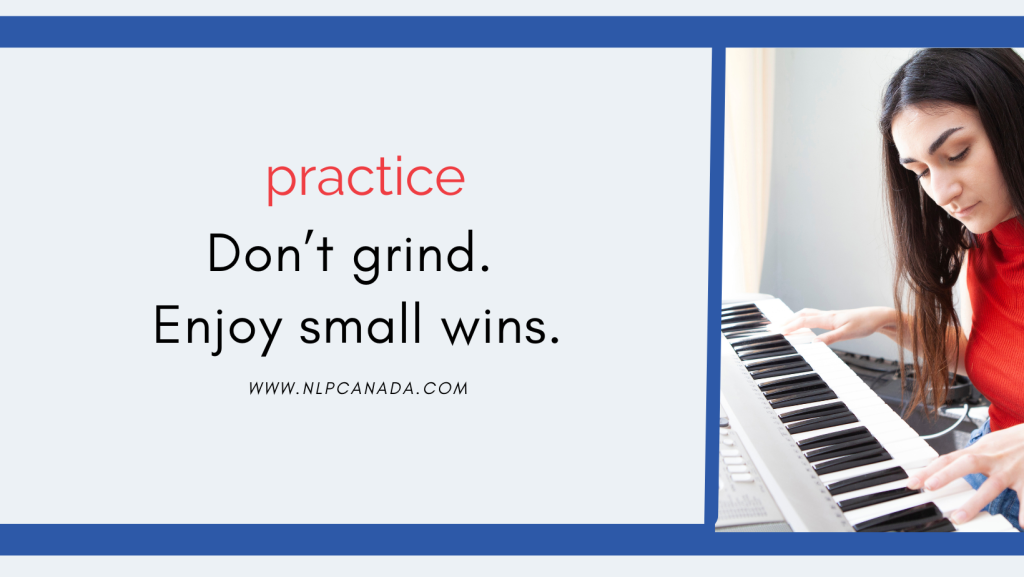
Practice: Don't grind. Enjoy small wins. Young woman playing a keyboard

You probably think that practice is a chore, something you grind out because it’s necessary. You know that mindful practice with feedback is an excellent way to progress and you’ll do it. . . when you’re not so busy or so tired. That’s one way to look at it.

Another way to look at it is that you haven’t learned how to practice effectively. If you had, you’d know that practice has benefits outside of the improvement of a skill.

Could you use some flow time? Time when you engage all of your attention is something that stretches you just enough so that your attention doesn’t wander. In NLP, we call this congruence. All of your attention wrapped up in one thing, a state where you learn efficiently and learning feels good. Wouldn’t it be great to let go of all the noise for a while?

Is it time to take a risk? One of the things that regularly inhibits innovation is people’s fear of being wrong. We fear making mistakes, and so we don’t try the new things that would make a difference. Good practice is always practice in making mistakes. Mistakes are a sign that you are reaching beyond your current competency so you can grow. If you are not making mistakes in practice, you’re not practicing right. That’s a reframe that prepares you for the chances you have to take to innovate and lead.

The flip side is also true. Practice is a reliable way to produce small, meaningful wins. And small wins are motivating. They don’t just make you feel good about what you have already done: they make you want to do more. When most of your projects are complicated and it’s hard to see what you have accomplished today, the small wins of practice sessions can keep you moving forward.

If you are a leader of people, you probably value their ability to stay focused, motivated, and innovative. Creating opportunities for mindful practice with feedback is no more complicated than creating team days that emphasize planning or learning. And only practice generates clear, research-backed benefits on so many fronts at once.


Share this post:

Related posts

Watch your step for NLP Canada Training image.
21 November 2026

Dumb NLP mistakes

A motif, in NLP terms, is an anchor. And like most anchoring, it works best when it takes advantage of one strong moment and creates echoes of that moment across different frames. It’s dumb to think that you can use an NLP technique in real life exactly as you used it in a classroom. In the classroom, conditions and boundaries were set to help direct attention. In a word that is becoming increasingly popular, the technique was situated. That means that it depended on context to work the way it worked. NLP is dumb when it is used without reference to context. You need to read the room, and then respond to what you read. There is no way to have influence without paying attention.
NLP Canada training session with instructor guiding a learner at a computer.
12 November 2026

How do you do it?

Have you ever wished that someone you lead, mentor or manage could do something that you do without thinking about it? Maybe you want to help them sell, negotiate, or plan. Maybe you want them to have a conversation that builds connection and shares clear information. They want to know: how do you do it? Your first instinct is probably to send them for coaching or training. Or if you don’t have that luxury, you might try to teach them the way you remember learning. Neither of those will teach them how you do it now. You will go through the same steps, but you’ll miss the cues that change your tempo, tone, or framing. You won’t know what you are doing automatically while your mind focuses on strategy or content.
Painting of a canal with a wooden walkway, trees and a red brick house
3 October 2026

Transformation starts in the senses

People want reframing to start with cleverness, a James-Bond-like ability to use a gadget or a quick move to change who is winning. But the beginning of reframing is framing: putting edges around a situation so that you can focus on the details inside the frame. Life is a movement between the moment, full of vivid details, and the future, which is hazy, moving, or shifting. Without movement we are stuck. Without the moment, we are lost in the haze.