Transformation starts in the senses

3 October 2026

By Linda Ferguson

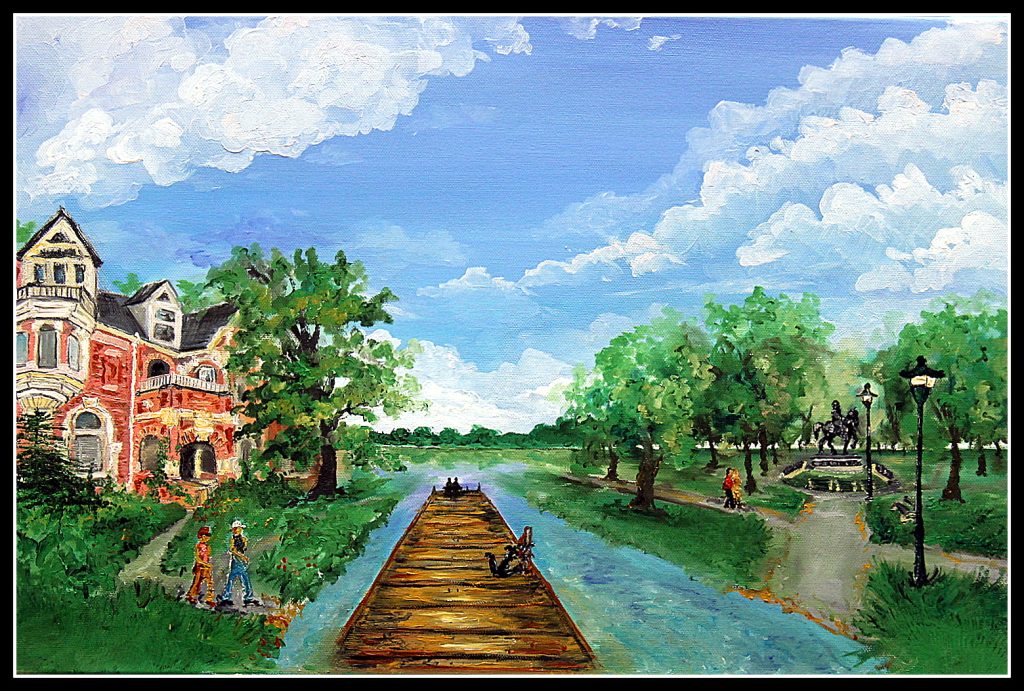
Painting of a canal with a wooden walkway, trees and a red brick house

Many people want transformation to start with words like “inspiration” or “vision.” I like those words too. But they are landmarks along the way: they are not the beginning. The beginning of transformation is formation: building or grounding in sensory experience.

People want reframing to start with cleverness, a James-Bond-like ability to use a gadget or a quick move to change who is winning. But the beginning of reframing is framing: putting edges around a situation so that you can focus on the details inside the frame.

Life is a movement between the moment, full of vivid details, and the future, which is hazy, moving, or shifting. Without movement we are stuck. Without the moment, we are lost in the haze.

If you need transformation to happen (because you don’t like the details now), begin by noticing the details, and then the edges around the details. I guarantee that as you pay attention to the details you will discover something you haven’t noticed before. And from that new awareness, you will grow a new form for your energy and identity.

Share this post:

Related posts

NLP Canada training session with instructor guiding a learner at a computer.
12 November 2026

How do you do it?

Have you ever wished that someone you lead, mentor or manage could do something that you do without thinking about it? Maybe you want to help them sell, negotiate, or plan. Maybe you want them to have a conversation that builds connection and shares clear information. They want to know: how do you do it? Your first instinct is probably to send them for coaching or training. Or if you don’t have that luxury, you might try to teach them the way you remember learning. Neither of those will teach them how you do it now. You will go through the same steps, but you’ll miss the cues that change your tempo, tone, or framing. You won’t know what you are doing automatically while your mind focuses on strategy or content.
Ladder reaching toward bright sky and sun flare.
7 November 2026

Is science a ladder or a bridge?

I’ve heard so many people make speeches based on the idea that science is somehow the highest form of knowledge and the people who practice it with big funding and large teams are also higher on some scale than the rest of us. And, like most dangerous attitudes, this mixes a little truth with a lot of bias and rhetoric. I think there is a better way of looking at science. I believe that good science extends our ability to know the world around us, and to know the processes within us. And I think that the reason for building that ability is not to raise some of us up and keep others down, but to build bridges between people and between people and the world they inhabit.
NLP Canada Training: woman in thoughtful pose in a blue layout.
31 October 2026

Why “space” backfires as a metaphor

Have you ever said, “I’d like to think about that, but I’m not in the right space for it.” Or maybe, “I’ll do it when I’m in a better space.” Generally, “space” is short for “head space” and it really means something like “I just don’t feel like thinking about that now.” But saying they’re not in the right space is a way of saying that their situation is somehow responsible for what they’re feeling. The danger in this is that it is partly true.