Do you need a plan or a flashlight?

11 January 2026

By Linda Ferguson

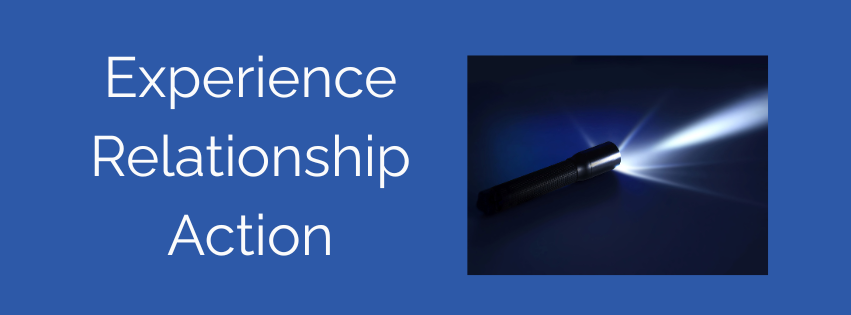
Experience, Relationship, Action, beside a flashlight beam in the dark

Have you ever tried to follow a map in the dark? While it’s great to have an image of the steps you need to take, it’s not easy to apply if you can’t see the way forward.

It’s often true that we make plans, and then it gets dark: something changes in the world around us that makes it hard to predict what will happen next. We are unsure that the steps we planned in one set of circumstances will be a good guide if we cannot see clearly what has changed or will change.

While change is happening, a plan is a reference but not a guide. It doesn’t tell us how to move through the steps ahead. Another way of saying this is that rational evaluation must be based on good information. If the information keeps changing, our analysis of how to move forward must also change. And often, that change will have to happen with incomplete or uncertain information.

This is when we need another way of seeing the steps closest to us. When we can’t plan effectively, we can still move forward in small actions and then notice the effects of our movement. We need a flashlight to show us next steps and then to show us how the landscape changes as we move forward.

Some of us use past experience as a flashlight. It might not give us an accurate view of the way forward, but knowing what has worked before can help us move forward enough to gather new feedback and identify new paths forward.

Some of us use values as a flashlight. We say, “I might not be certain about the world around me, but I can be sure what I believe” and so we use what we believe to be good to generate the movement we need to explore what is possible.

And some of us use examples as a flashlight. Someone else’s experience in another time or place might not be an exact match for our new situations. But the way that someone else managed to keep moving through uncertainty can help us choose a next step. Each step shows us something new about the circumstances, and allows us to choose the following step.

A flashlight is never as reassuring as a good map and the light to see it (and your surroundings). But when it gets dark around you, a flashlight allows you to keep moving.
Share this post:

Related posts

Watch your step for NLP Canada Training image.
21 November 2026

Dumb NLP mistakes

A motif, in NLP terms, is an anchor. And like most anchoring, it works best when it takes advantage of one strong moment and creates echoes of that moment across different frames. It’s dumb to think that you can use an NLP technique in real life exactly as you used it in a classroom. In the classroom, conditions and boundaries were set to help direct attention. In a word that is becoming increasingly popular, the technique was situated. That means that it depended on context to work the way it worked. NLP is dumb when it is used without reference to context. You need to read the room, and then respond to what you read. There is no way to have influence without paying attention.
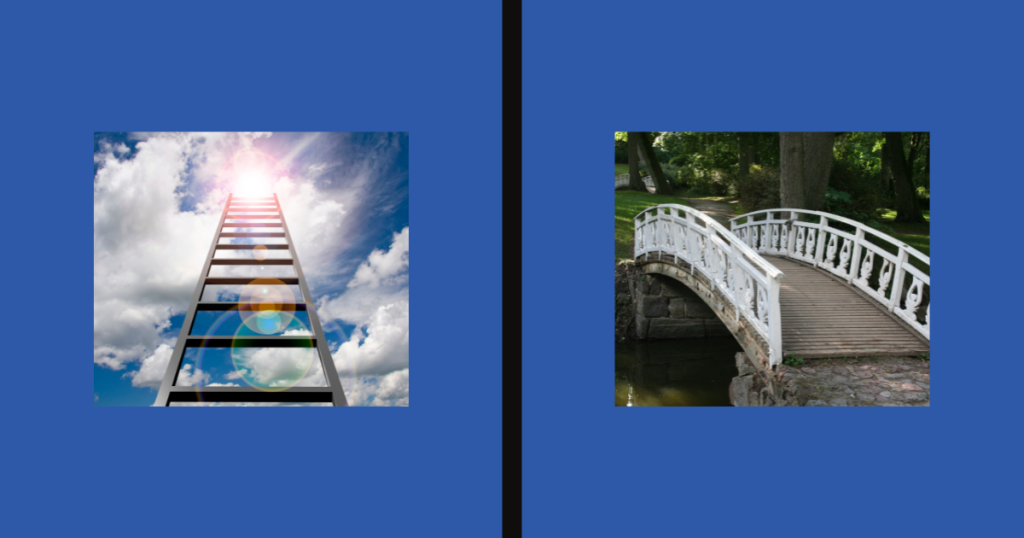
Ladder reaching toward bright sky and sun flare.
7 November 2026

Is science a ladder or a bridge?

I’ve heard so many people make speeches based on the idea that science is somehow the highest form of knowledge and the people who practice it with big funding and large teams are also higher on some scale than the rest of us. And, like most dangerous attitudes, this mixes a little truth with a lot of bias and rhetoric. I think there is a better way of looking at science. I believe that good science extends our ability to know the world around us, and to know the processes within us. And I think that the reason for building that ability is not to raise some of us up and keep others down, but to build bridges between people and between people and the world they inhabit.
NLP Canada Training: woman in thoughtful pose in a blue layout.
31 October 2026

Why “space” backfires as a metaphor

Have you ever said, “I’d like to think about that, but I’m not in the right space for it.” Or maybe, “I’ll do it when I’m in a better space.” Generally, “space” is short for “head space” and it really means something like “I just don’t feel like thinking about that now.” But saying they’re not in the right space is a way of saying that their situation is somehow responsible for what they’re feeling. The danger in this is that it is partly true.