
Rolling with the punches

19 September 2026

By Linda Ferguson

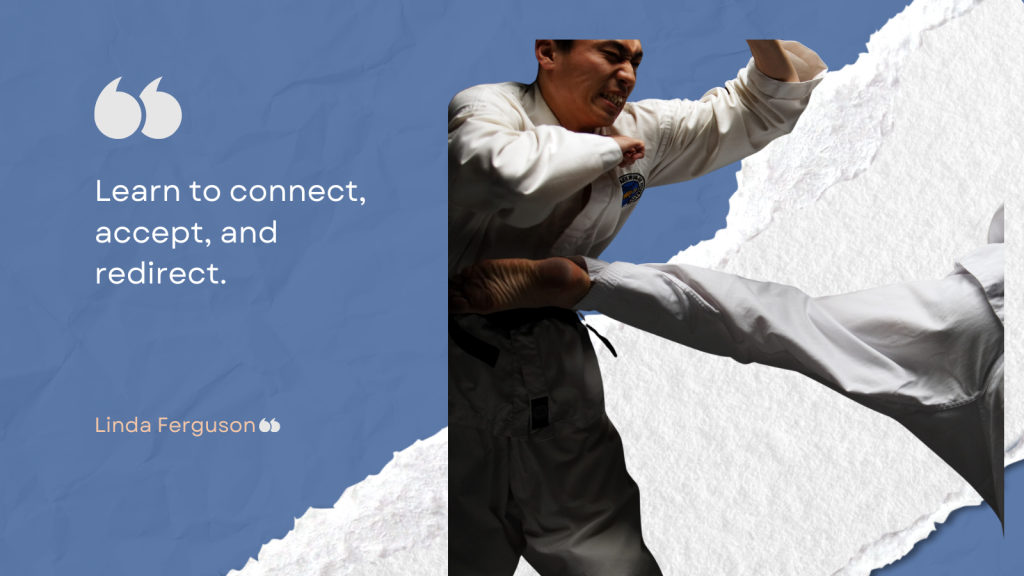
Martial artists sparring

Do you know why people need to roll with the punches? Like many metaphors, it is more direct and more pragmatic than you might expect.

A boxer learns to roll with the punches instead of encountering them head on with resistance. They learn because taking the punches hurts more than rolling with them.

Aikido adds the next step. You move with the attack, find a pivot, and change direction. It does no good to encounter the attack straight on, and it does no good to accept it without a plan for your next move.

This is a part of emotional intelligence and rapport that people often miss. It’s easy to imagine making better emotional choices on your own. It’s less easy to imagine what emotions are useful when you feel you are being attacked. It’s harder still to imagine how to take the energy in a heated encounter and turn it in a useful direction.

Here’s another way to look at it. When people pay attention to each other, their states synchronize. They begin to match and mirror behaviours so that they can interpret the other person’s feelings and intentions. The state that dominates is usually the one with the most energy. It’ s not always a combative state, but when it is, two people are now combatants.

If you want to win the rapport game, you need to know more than how to reflect what you observe in someone else. You need to know how to reflect, gain attention, and then move to a more useful state. That more useful state needs to use the energy present in a new way and in a new direction.

People learn to box and roll with the punches. They learn aikido. They can also learn to counter their intuitions and connect in difficult situations without amplifying conflict. It’s easier with a skilled teacher and lots of practice.
Share this post:

Related posts

Martial artists sparring
19 September 2026

Rolling with the punches

If you want to win the rapport game, you need to know more than how to reflect what you observe in someone else. You need to know how to reflect, gain attention, and then move to a more useful state. That more useful state needs to use the energy present in a new way and in a new direction. People learn to box and roll with the punches. They learn aikido. They can also learn to counter their intuitions and connect in difficult situations without amplifying conflict. It’s easier with a skilled teacher and lots of practice.
12 September 2026

What’s the difference a workshop and a certification?

What’s the difference between experiencing NLP in a workshop and what you can learn in a certification? A workshop is like tasty appetizers: you enjoy them but they’re not a real meal. The certification shows you all the pieces and it shows you how they fit together, from appetizers to dessert.
Reach for it
8 August 2026

What inspires you?

Often plodding forward in uneven lighting is exactly what we are called to do. We learn from biographies of the great creators that their lives were less about lightning bolts of understanding and more about showing up and believing the next step would lead somewhere good. This should not let our leaders off the hook, as though we don’t need any spark to light our best thinking. It should, instead, make them aware that lots of little sparks of connection and vision and discipline can come together to inspire in a way that a dazzling image of the future might not.

The NLP Practitioner Certification Details and Pricing

NLP Canada Training Practitioner Certification

At NLP Canada Training, you’ll work with a community that turns the best evidence into

practical techniques. Ask questions, practice hard, and have fun while you learn to make

change happen in you and around you.

Course Content

The course is structured to allow practice of the four core skills of NLP: managing state; managing rapport and connection; recognizing patterns in language and behaviour; and setting effective intentions and goals. Each day, different aspects of these skills are learned in relation to solving a problem or developing a direction. The course includes recognizing and making the most of emotions, connections, limited resources, stress, negotiation and collaboration, influence, and learning and development.

Pricing

Individual plus Individual Application Sessions (3) $2285 + tax

Individual $1885 + tax

Couples, Groups, Retired Seniors, or Full-Time Students, $1425 + tax per person

NLP Practitioner plus the NLP Master Practitioner, $3285 + tax per person

*Tax is applied depending on the province or country in which you reside.

Payment Plans

We’ll work with you to develop a payment plan you can manage. Normally a 20% deposit is

required before the course begins. This is non-refundable but can be applied to a future session of the certification if your plans change.

Payment can be made in full or by installments (normally 3-5). All payments are made through your credit card or bank using QuickBooks payments.

Live on Zoom

Training is live on Zoom and you will spend most of your time in a breakout space with one or two other people. Days run from 10:00 AM Eastern to 5:30 PM Eastern (Adjust for your time zone). We never record and we do not allow recording.

Dates for 2026/27

Season


Start

All Session Dates

Summer/Fall 2026

Fri. Sept 11

 Fri/Sat/Sun Sept 11/12/13 and Fri/Sat/Sun Oct 2/3/4 and Sat/Sun Oct 17/18

Fall 2026

Fri. Oct 30

Fri/Sat/Sun Oct 30/Nov 1 / 2 and Fri/Sat/Sun Nov 13/14/15 and Sat/Sun Nov 28/29

Winter 2027

Fri. Jan 22

Fri/Sat/Sun Jan 22/23/24 and Fri/Sat/Sun Feb 5/6/7 and Sat/Sun Feb 20/21

Spring 2027

Fri. Mar 5

Fri/Sat/Sun Mar 5/6/7 and Fri/Sat/Sun Mar 19/20/21 and Sat/Sun Apr 3/4

Late Spring 2027

Fri. Apr 23

Fri/Sat/Sun Apr 23/24/25 and Fri/Sat/Sun May 14/15/16 and Sat/Sun June 5/6

More Questions? Contact us for a free consultation

Email: linda@nlpcanada.com

Office: 416-928-2394

Cell: 289-242-5089