Have you ever tried to follow a map in the dark? While it’s great to have an image of the steps you need to take, it’s not easy to apply if you can’t see the way forward.
It’s often true that we make plans, and then it gets dark: something changes in the world around us that makes it hard to predict what will happen next. We are unsure that the steps we planned in one set of circumstances will be a good guide if we cannot see clearly what has changed or will change.
While change is happening, a plan is a reference but not a guide. It doesn’t tell us how to move through the steps ahead. Another way of saying this is that rational evaluation must be based on good information. If the information keeps changing, our analysis of how to move forward must also change. And often, that change will have to happen with incomplete or uncertain information.
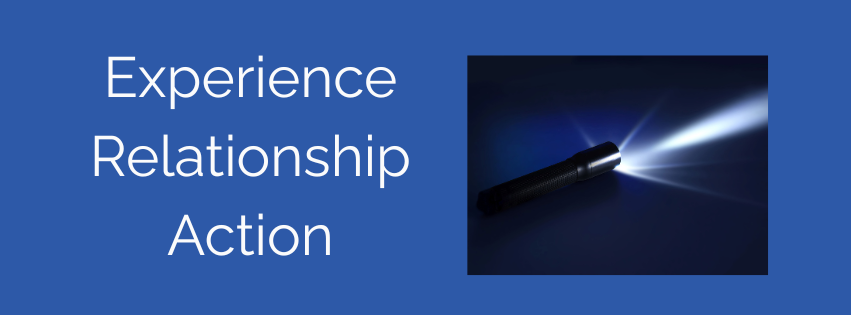
This is when we need another way of seeing the steps closest to us. When we can’t plan effectively, we can still move forward in small actions and then notice the effects of our movement. We need a flashlight to show us next steps and then to show us how the landscape changes as we move forward.
Some of us use past experience as a flashlight. It might not give us an accurate view of the way forward, but knowing what has worked before can help us move forward enough to gather new feedback and identify new paths forward.
Some of us use values as a flashlight. We say, “I might not be certain about the world around me, but I can be sure what I believe” and so we use what we believe to be good to generate the movement we need to explore what is possible.
And some of us use examples as a flashlight. Someone else’s experience in another time or place might not be an exact match for our new situations. But the way that someone else managed to keep moving through uncertainty can help us choose a next step. Each step shows us something new about the circumstances, and allows us to choose the following step.
A flashlight is never as reassuring as a good map and the light to see it (and your surroundings). But when it gets dark around you, a flashlight allows you to keep moving.