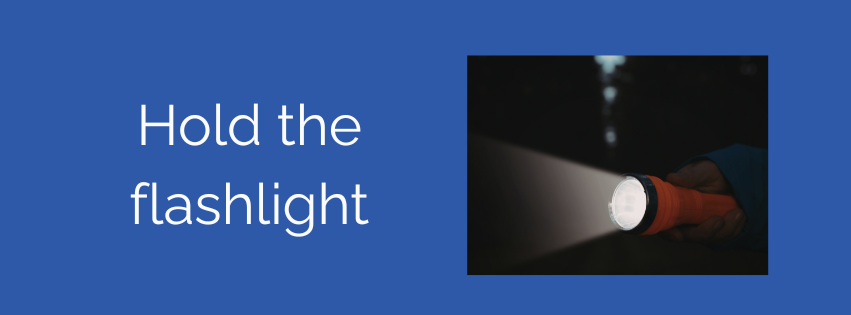
Sometimes, we need both hands to do what we want to do. If we need more light for clarity or direction, we need someone else to hold the flashlight. Have you ever held the flashlight so someone else could see better?
You might not have any home repair stories that come to mind, But I bet you can think of something you have done for someone else that was not a big deal for you, but it was a big deal for them. I remember one of my first tutoring experiences. We were in grade eight, and I was helping a friend with math. I’m not sure what she learned. I learned that if you can work hard and understand you are luckier than the people who are working harder and still not getting it. Some of us work hard and see the light at the end of the tunnel. Sometimes, we work hard and need someone else to hold a flashlight.
Start with a real experience of holding a flashlight so someone else could see. What were they trying to do (with both hands) that depended on someone else shining a directed beam of light on just the right thing while they focused? Were they trying to walk through the words, or fix a small appliance? Instead of thinking in the abstract, pick one specific time when you helped by holding the flashlight.
Sometimes, we have to depend on ourselves to shine the flashlight so we can move forward. A bright spot in memory is like a spotlight on a stage: it shows you one thing in bright light and dims out the surroundings. To turn that bright spot into a flashlight, you have to point the light differently so that it helps you focus or move in a new direction. You can easily imagine doing it with a real flashlight.
When your flashlight is metaphorical, you begin with the question: “in a situation where there isn’t enough light or logic to see clearly, what do I most need to be able to see?” And the answer comes from a bright spot, a time you paid attention to the right thing so that you liked the opportunities you found or the thing you achieved. Now you can point your attention at the same kind of thing in your current situation. That’s how you turn your bright spot into a flashlight.